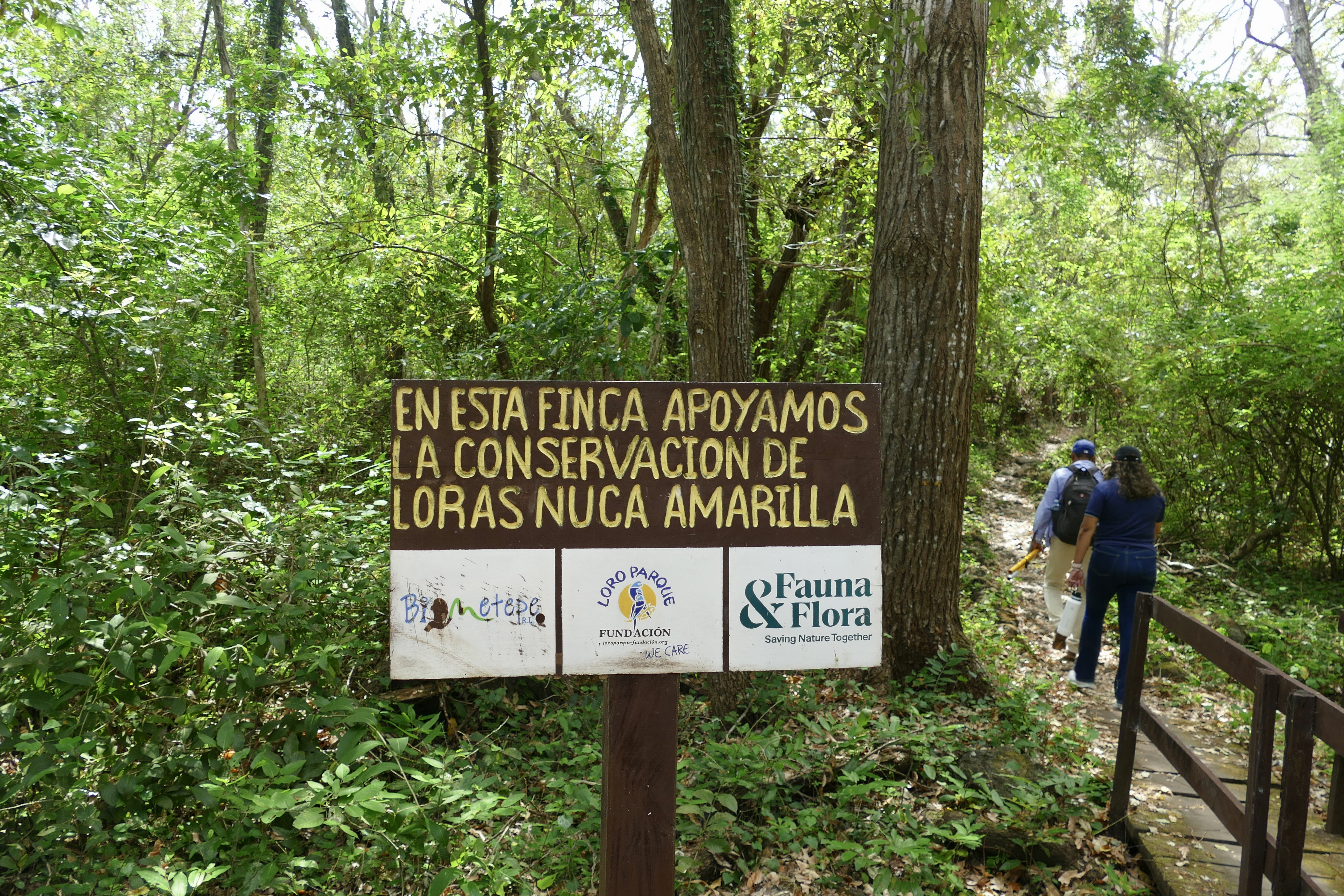
Field Notes: Nicaragua, March 2025
Climbing for parrots.
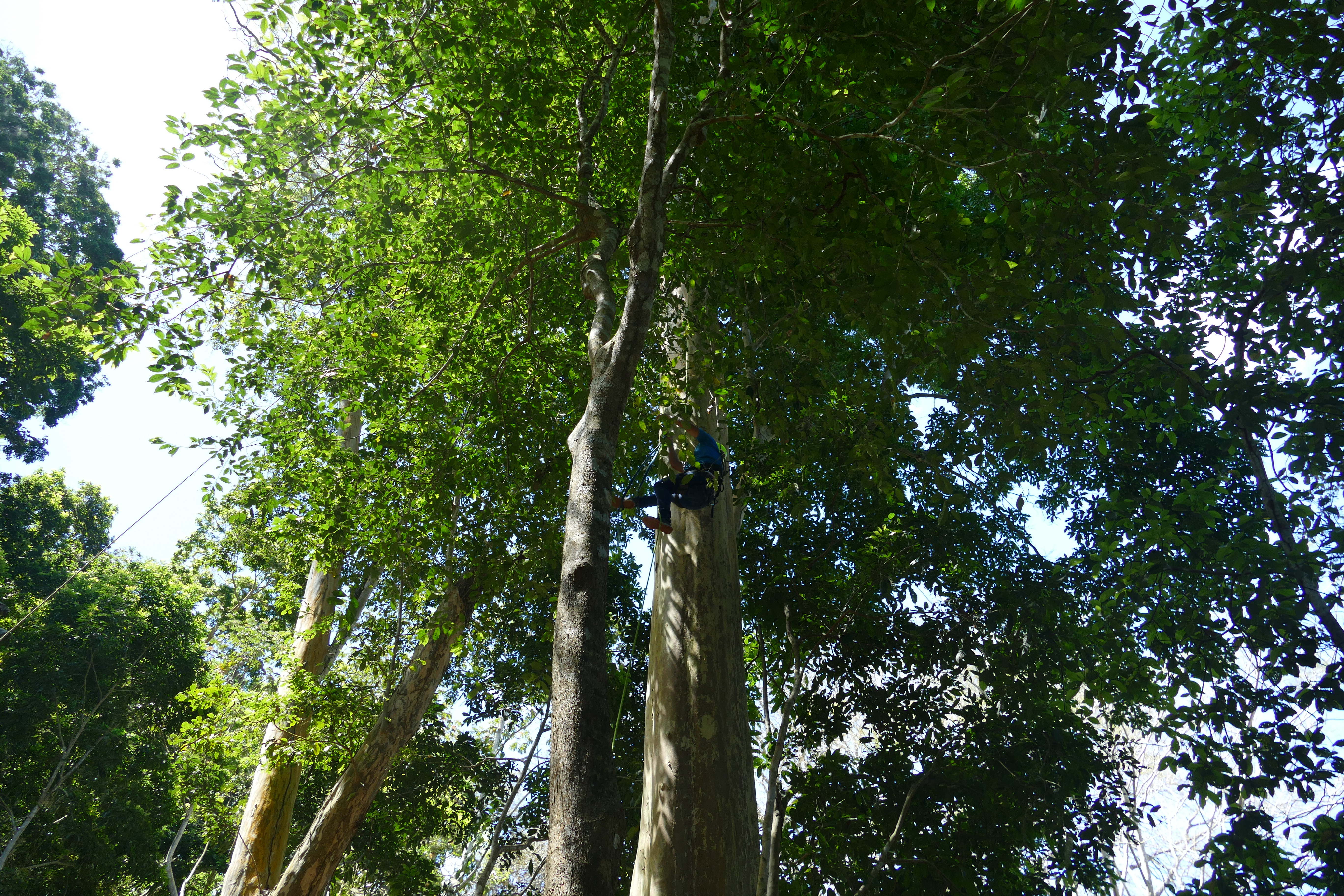
Scaling a tree was not what I had expected to be doing on Ometepe Island. Yet here I was, dangling from my harness, looking down into a yellow-naped amazon parrot's nest at two featherless, scaly, greyish chicks.
A squawk from one caused a brief heart-jump, quickly replaced by quiet wonder, and an uneasy awareness of how vulnerable these still-flightless chicks really were. High up in a tree hole, yes, but once the tree was scaled, they were there for the taking. This was exactly what the Biometepe team spends its days working to prevent.
I'd met the team that morning: Adonis, Norlan and Emerson, Biometepe's parrot guardians. During nest-monitoring season, the three of them spend their days climbing the 30-metre (100-foot) trees where Ometepe's yellow-naped parrots build their nests, and today it was my turn to see, first-hand, what checking on a season's chicks involves.
Adonis went up first, partly to show me how it was done, and partly to check on the chicks himself. Before I could even finish adjusting my own harness, he'd all but run up the tree's trunk and was back down again. "See? It's easy," he said, grinning. It was not, in fact, easy.
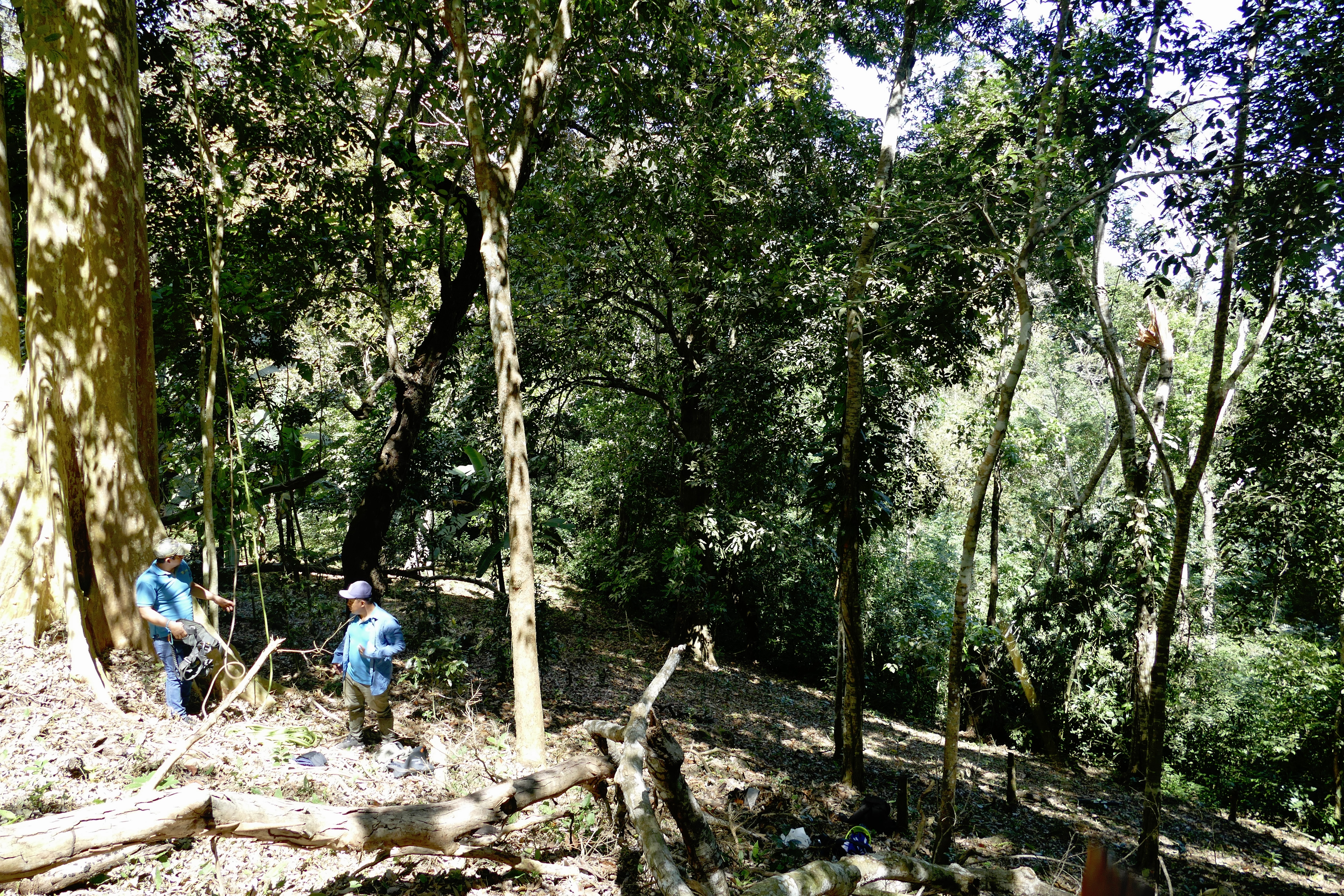
Climbing for parrots is a three-person job. First, the rope, weighted with a hook, must be launched up and over a branch until it catches and holds, usually with a handheld line launcher, and usually after several failed attempts. One person then keeps tension on that end of the rope: the securer. The climber is harnessed in. A third, the puller, holds the base of the line, both to help hoist the climber up and to keep them safe if anything goes wrong.
Climber, securer, puller: each role is as essential as the last, and the job is impossible with only two.
It is slow, exhausting work, and frustrating whenever the rope refuses to catch. This time, it was me in the harness, with Norlan securing the rope and Emerson holding the line below. I was instructed to pull with my arms while pushing with one foot looped through a pulley on my harness, propelling myself up the rope a few inches at a time.
I started well, but it was tiring work, more so as I climbed into the canopy and had to start dodging rogue branches. Just as my arms began to give out, the canopy broke: a camera trap came into view above me, and, in the trunk in front of me, a bowl-shaped hollow holding two flightless chicks, entirely unbothered by my presence.
It is beautiful up here. Spinning slowly in my harness, I could see the whole of Ometepe Island spread out below: the lake glinting, Volcán Concepción rising from its center. The canopy is not a quiet place. Wind whispers its way through the leaves, birds call to one another, insects scrape and burrow, and underneath it all, the soft whoosh of the chicks breathing in their nest.
The yellow-naped amazon, on the edge.
The yellow-naped amazon (Amazona auropalliata) is not, despite the name, found anywhere near the Amazon; its range runs instead from southern Mexico to northern Costa Rica, thinning at both ends and vanishing almost entirely in Mexico, Guatemala and Honduras, where trapping has taken its toll. It is precisely the qualities that make the parrot so charismatic — a gift for mimicry, a bold sulphur-yellow collar — that also make it so coveted. Poachers prize it for the pet trade and are willing to climb the very trees I was now hanging from to get it.
The species is listed as Critically Endangered, and nowhere does it hold on more successfully than on Ometepe. But that number is more fragile than it sounds, because mated pairs tend to return to the same nest year after year. Once a poacher has identified a tree as having an active nest, they know exactly where to come back the following breeding season — underpinning just how important the work of local parrot guardians like Adonis, Emerson and Norlan is.
Endangered
The tree I was dangling from happened to be one such tree. The camera trap above the nest was there for two reasons: as a deterrent to poachers, and to help collect scientific data on parrot behaviour. And here I was, staring down into a tree hole at the future of this species.
But it was time to say goodbye: I had been seated in my harness long enough and thought I was starting to lose blood flow to my legs. The descent was far easier, and quicker, than the climb up. This was where Norlan and Emerson came into their own, holding tension on my rope, ready to stop me should my descent become uncontrolled.
Back on the ground I was reminded how unglamorous most conservation work is. Already Adonis, Norlan and Emerson were coiling up their rope with practiced efficiency. Throughout the nest-monitoring season they scale multiple trees each day, hiking through the forest to reach each one. Day in, day out they do this, not for recognition or praise but for what may be deemed a rather old-fashioned set of reasons: a love for a particular bird, a loyalty to a particular island, and a quiet conviction that we are better off living alongside nature than in spite of it.
Biometepe's work on Ometepe Island is proof that community-led conservation protects a species: people willing to climb the same trees, season after season. Adonis, Norlan and Emerson are showing how the survival of the yellow-naped parrot is being built one tree, one nest, and one very tired pair of arms at a time.